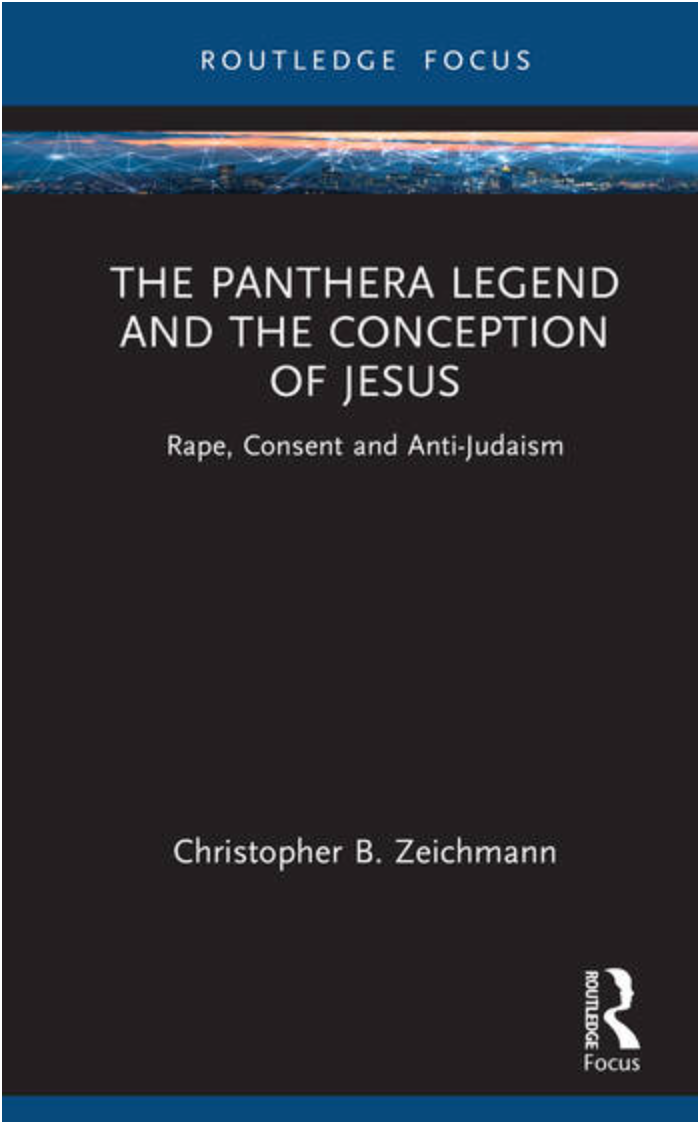
The next volume in our Routledge Focus book series Rape Culture, Religion and the Bible is soon to appear. The official publication date is 10 July 2026 and you can read a blurb and find out more here!
The book’s title is The Panthera Legend and the Conception of Jesus: Rape, Consent and Anti-Judaism. Here is a Q&A with the author, Christopher B. Zeichmann.

·
Tell us about yourself!
My name is Chris Zeichmann and I am a specialist in the New Testament who teaches at Toronto Metropolitan University. My research mostly revolves around the Roman imperial context of early Christianity, focusing most especially on the military and the Gospels. I find it fascinating how early Christian texts espouse wildly different opinions about the military forces in the region, some positive (like the centurion Cornelius in Acts 10), some negative (like the soldiers mocking and crucifying Jesus), and some difficult to parse (like the demon named “Legion” in Mark 5).
· How did this book come about, and how does it relate to your work more broadly?
One other topic that I’ve found fascinating is the connection between the military and sexual violence. This is a topic I’ve written about before, including for the Shiloh Project!
This particular book arises from the question about Jesus’ conception; there is an ancient legend that Jesus was not the son of God or even Joseph, but of a soldier named Panthera. This is first mentioned in the works of the pagan philosopher Celsus, who around 180 CE wrote a long work criticizing Christianity. Since then, various other people and sources have discussed the story with different levels of detail: the Babylonian Talmud discusses it, the church historian Eusebius mentions it briefly, and many manuscripts of the medieval Jewish novel called The Toledot Yeshu offer a narrative account of how Panthera impregnated Jesus’ mother. This is not to mention how archaeologists discovered the tombstone for a soldier with the name Panthera, a soldier who was born not too far from Galilee!
All of this raises a number of questions, whether for historians or theologians. How accurate are these legends? What do we know about Panthera? What might all of this mean for the doctrine of the virgin birth? Does this mean that Jesus was actually half Roman?
In this book, I try to explain the history of the Panthera legend, from its origins to the present day. But in doing this, I try to situate the legend amid the changing rape cultures of global history, asking how this story was used to reinforce certain conceptions of sexuality and virginity, drawing particular attention to how Christians discussed the Panthera legend in relation to Jewish people.
· What are the key arguments of your book?
To start with, the book suggests that there isn’t really any good reason to take the Panthera legend seriously as a historical explanation for Jesus’ birth. The evidence for the legend comes from long after Jesus’ death and from sources that are not particularly reliable.
Where I think things get more interesting is with the idea that even though Christians insisted that Jews created this legend and were the primary articulators of the legend, there is surprisingly little evidence that this is the case. Rather, I suggest that Christians fixated on this Jewish origin of the legend – since there are far more Christians writing about it than Jews or pagans – to make various points about the doctrine of the virgin birth. In the early centuries of Christianity, there were a striking range of opinions about how Jesus entered the world: many Christians claimed that Jesus was born of normal sexual intercourse between Mary and Joseph, other Christians claimed he spontaneously manifested on earth of his own divine will, other Christians claimed that Jesus only seemed to be fleshly and was never born at all. One of my suggestions is that proto-Orthodox Christians fixated on the Panthera legend as a way of shaming other Christians into accepting the doctrine of the virgin birth. For instance, the Church Father Origen writes that even Jews who believe Panthera was the father of Jesus implicitly acknowledge that Jesus was not born of a normal human marriage – surely all Christians should acknowledge the same, right? Thus, “Jews” became a shaming device to bring non-orthodox Christians into the fold.
· What do you hope readers will take from this book?
From the moment I started thinking about writing this book, I knew I wanted it to be in the Rape Culture, Religion and the Bible book series, because of the important work the editors and contributing authors have done on the topic of sexual violence. With my own contribution, I hope readers will come away with a better sense of how rape has been normalized in the way we discuss the virgin birth of Jesus and related stories. Many people – scholars included – are very flippant about questions of consent when it comes to the conception and birth of Jesus. It is easy to gloss over these questions, in large part because biblical texts encourage us to do so! The Gospel of Luke, for instance, really fixates on how Mary “submits” to God’s will when she learns that she is chosen by God. Or, to go in another direction, people often make jokes about the rape of Mary, implying that she may have liked it: Monty Python’s Life of Brian being a particularly famous example of this. We can and should be more careful in how we discuss such things.
· What makes your book relevant and important?
The Panthera legend continues to have currency in popular culture. A few recent movies, too, depict some version of it: Kevin Costner Presents: The First Christmas (2025) and The Carpenter’s Son (2025) are both Hollywood productions that bring up the possibility that Mary was raped by a soldier. Director Paul Verhoeven (of RoboCop fame) has said he would open a Jesus movie with a similar scene. It is important to think about why the Panthera legend continues to remain compelling in the minds of many, but also what exactly someone is suggesting about rape, Judaism, and Christianity when they bring it up.
· Give us one quotation from the book that you think will make a reader go and read the rest.
[Much of this book concerns] how “Jewishness” and “Judaism” figure deeply into the Panthera legend and the supposed origins of this tale. We will see that Christian and pagan writers claim this legend was formulated and then perpetuated by Jews. Moreover, questions of Jesus’ Jewishness rise to the fore when interpreters consider its implications. Through their discussion of the Panthera rumour, Christian interpreters construct a fictitious figure of “the unbelieving Jew” who maligns Christianity and weaponizes this legend against Mary’s virginity. This is striking, because we will see that Jews throughout history have shown remarkably little interest in this legend, let alone using it to attack Mary. Instead, this book will argue that Christians have constructed this “unbelieving Jew” not to address what Jews were actually saying, but to clarify the parameters of their own doctrines and orthodoxies.
*The image is used with the permission of Chris Zeichmann.