close

Uncategorized

New Book by Jessie Ini Fubara-Manuel

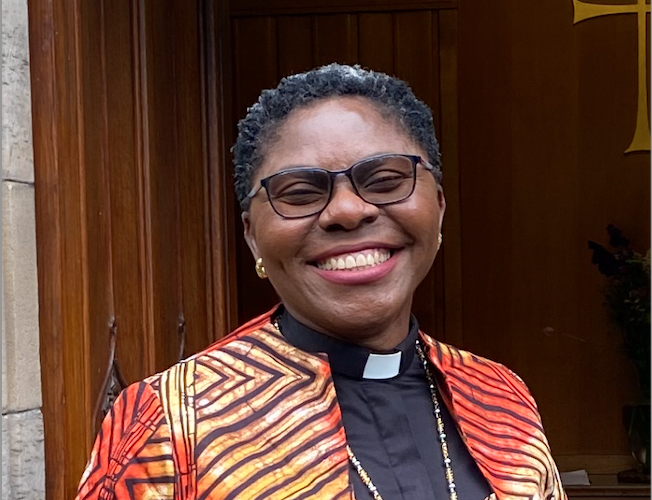
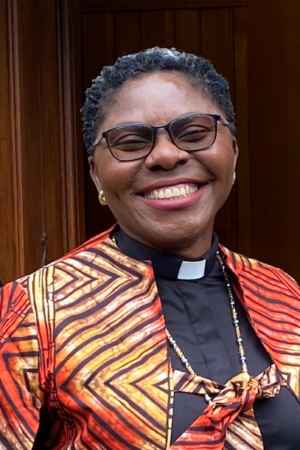
portrait of the author smiling

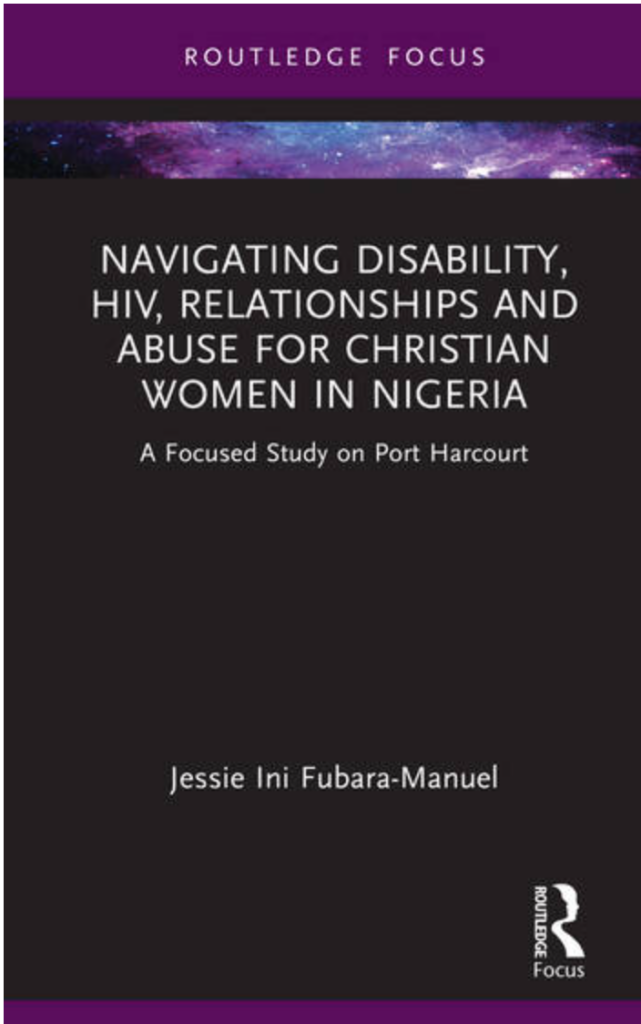
Today’s post is all about Dr Jessie Ini Fubara-Manuel, author of a forthcoming book in the Routledge Focus book series “Rape Culture, Religion and the Bible.” The title is Navigating Disability, HIV, Relationships and Abuse for Christian Women in Nigeria: A Focused Study on Port Harcourt, and the book’s release date is 22 July 2026. We anticipate that it will soon be open access. For purchase and access details, see here. Read on to find out more!

Tell us about yourself

I am an ordained minister, researcher, author, and advocate for gender justice and disability inclusion across pastoral ministry, theological research and teaching, and public engagement. As a theologian, I am deeply committed to how elite theological discourses are being reinterpreted in lived theology, as expressed in issues of relationships, gender, disability, and HIV. I live actively in two worlds. I am currently a Pastoral Assistant at Edinburgh Northwest Kirk Church of Scotland, and an Adjunct Lecturer at Essien Ukpabio Presbyterian Theological College, Itu, Nigeria. I recently accepted a position with Leeds Church Institute as Leeds Churches Theologian and look forward to bringing people together in welcoming spaces where churches can reflect, learn, and grow together in faith and witness.

How did this book come about, and how does it relate to your work more broadly?

The United Nations estimates that globally, 1 in every 3 women will experience gender-based violence in their lifetime. This may be conservative. Some reports, including in newspapers and on social media, suggest that 1 in every 2 women face some form of domestic and intimate-partner abuse.  I caught several glimpses of accounts of sexual abuse and rape suffered by women with disabilities during my ethnographic PhD research in Port Harcourt. Most disheartening were the stories of women with disabilities who were raped and knowingly infected with HIV by men with whom they shared marital or, at least to begin with, friendly relationships.

My post-doctoral research, consequently, focused on these stories, asking critical questions such as: what were the types of relationships and the circumstances in which rape occurred for these women? (How) did the victim and rapist navigate consent? What were the effects of rape on the health and identities of victims? How did the women make sense of their faith in these challenging situations? How did their gender and disability increase their vulnerability to sexual abuse and rape? What role did patriarchy play in all these?

This book is an effort to bring to the fore the voices and stories of Christian women of Port Harcourt, Nigeria, who, on account of their disabilities, were vulnerable to and harmed by sexual violence and subsequently were infected with HIV. It is the result of my commitment to “speak up for those who cannot speak for themselves” (Proverbs 31:8-9).  But it goes beyond mere speaking up; it is about collectively reimagining and creating spaces of justice, respect, love and equality.

What are the key arguments of your book?

Beyond the statistics are actual women for whom rape, HIV+ status and disability are a reality and who face multiple forms of stigmatisation – daily. Whereas gender-based violence affects both men and women as perpetrators and victims, this book supports research that more women are victims of gender-based violence.

Patriarchy enables and entitles men to act in ways that dehumanise and diminish the value of women. I argue that a conversation must be had with men to understand how patriarchy shapes men’s behaviour towards women. Men and women, especially those with disabilities, must have this conversation about gender-based violence in equitable spaces, with respect, theological reflection and genuine love.

Although the significance of faith in the lives of abused women is not always appreciated, faith does inform how Christian women living with both disabilities and HIV+ status make sense of life after abuse and how their identities and relationships are forever impacted.  Faith leaders must be adequately trained to offer life-giving, liberating and gender-sensitive theologies to their adherents.

What do you hope readers will take from this book?

That beyond the statistics are faces and lives of everyday ordinary women who suffer various forms of unimaginable abuse, including sexual abuse. Moreover, these statistics often lack women with disabilities because they are very often overlooked and silenced and are unable or unwilling to report rape due to anticipated stigma.

Reporting rape needs community support and accompaniment, whether of friends, family or the church.  I hope readers will pause, treat these stories with respect for the survivors and articulate ways to eliminate gender-based violence and the systems that enable rape culture within our societies and churches. I hope there will be intentional accompaniment of women with disabilities and HIV as they navigate what healing means when issues of betrayed trust, rape, infection and loss of relationships take place.

I have taken time to discuss albinism and the fatality of albinism, which is not given the necessary medical attention, and also the myths that engender sexual abuse for women with albinism. I trust this will be a learning point for many people, especially those who never considered albinism – at all, or as a disability. I hope that there will be more awareness of the implications of disability for poverty and inequality to thrive and for stigma to eliminate women from the economic marketplace.

Relationships should be sacred spaces that enable the flourishing of those who engage in them; as such, the simple ethos of protection and love needs to be upheld. Love does not hurt; it does not take advantage of the vulnerable, and it does not deliberately expose one to danger. Sexual assault and rape do not end when the act is past; the trauma of rape stays with the victim for a lifetime, directly and indirectly affecting other relationships.

What makes your book relevant and important

The issues that this book addresses are contemporary, heart-wrenching issues that affect women globally, perhaps worse so in societies where the powers of patriarchy are unchecked. Unfortunately, these issues are far from the stuff of history books. Social media is replete with stories of gender-based violence and rape of women by men in all kinds of different spaces and places. This book brings to the fore the stories of women with disabilities who were infected with HIV – intentionally, deceitfully, abusively.  Stories such as these are under-represented and rarely documented.

Port Harcourt is a prominent city in Nigeria, with the reputation of being the oil capital, bringing focus to the fight for resource control, militancy, and patriarchal power; while the negative side-effect of intimate partner violence is most often hidden. Also, the legal frameworks do not adequately protect women with disabilities, and the “indecent exposure” clause can harm women and discredit their reports of rape. These contextual facts must be known to faith actors and other agents as they seek to address rape culture in Port Harcourt.

With efforts to eliminate the scourge of gender-based violence in Nigeria ongoing, this book contributes to that endeavour, advocating for the inclusion of the lived experiences of women with disabilities and HIV. This book also contributes to the Circle of African Women Theologians’ efforts to expose and challenge the structural conditions that enable sexual abuse and rape against women. It does so by grounding women’s experiences in African theological discourse.

Give us one quotation from the book that you think will make readers go and read the rest.

The quote below is a reflection on one of the stories in the book by Lily (pseudonym).

Therefore, it was not an either/or state or sense-making for Lily.  She was neitherhappy nor sad, trusting or distrustful, despairing or hopeful. She was in the in-between-ness that was beyond explanation. Rape tarnishes. Sexual abuse is not “just sex” or just of the body; it is a turbulence in the mind that stays on when the body is washed clean of the sperm or blood stains of physical intrusion. When Lily (and, in fact, most of the other women) spoke of her rape, she would unconsciously wrap her arms around herself, like a hug of sorts, consoling the body of the trauma it had endured.

We hope many will read this powerful and important book. For anyone in the Leeds area, Dr. Jessie Ini Fubara-Manuel will be presenting on her research for this book at the Centre for Religion and Public Life (University of Leeds) seminar on 1 October 2026. For details, please contact Johanna ([email protected]).

PS: Another recent book in the series, published earlier this month, is by Christopher Zeichmann, and an earlier book in the series, by Sarojini Nadar, is appearing in paperback on 27 August 2026. For details, see here.

read more

Call for Participants: Survival & Recovery in Victim-Survivors of Adult Clergy Sexual Abuse

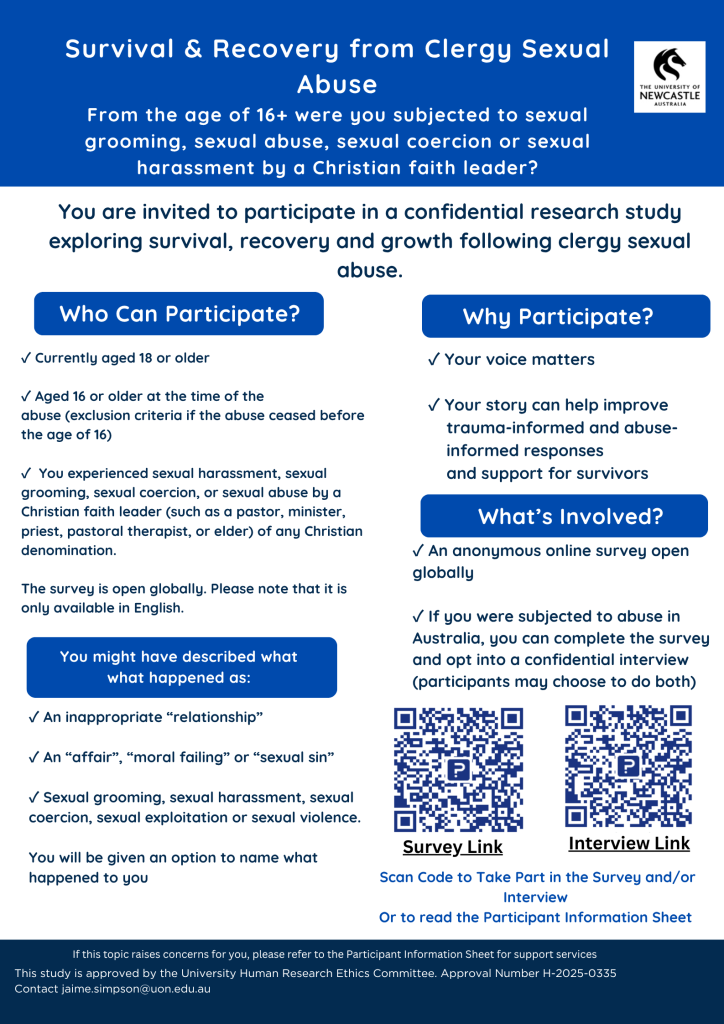
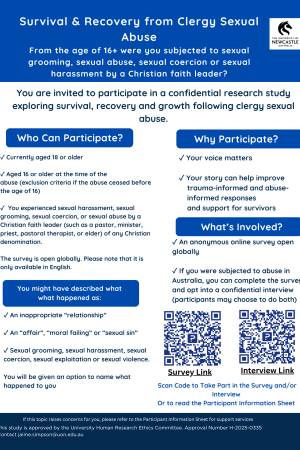
poster with QR code

This call is for participation in a university research project led by Jaime Simpson. Simpson is PhD candidate in the School of Humanities, Creative Industries and Social Sciences (in Sociology and Anthropology) at the University of Newcastle (Australia) under the supervision of Kathleen McPhillips and Chris Krogh. The call applies to English-speaking adults worldwide aged 18 years or older who experienced sexual abuse or sexual exploitation by a Christian faith leader during mid-late adolescence (16+) or adulthood. The faith leader can be from any Christian denomination. If this applies to you and if you would like to participate, please see below. For additional information, please contact Jaime Simpson directly: [email protected]

Have you experienced sexual grooming, sexual abuse, or sexual coercion by a Christian faith leader when you were age 16 or older?

You are invited to participate in a confidential research study exploring survival, recovery and growth following clergy sexual abuse.

This research study invites English-speaking adults worldwide to share their experiences anonymously via an online survey (45–60 minutes).

For people subjected to abuse in Australia, there is also an option to participate in a confidential interview (with a female researcher).

Your story can help shape a better understanding of clergy abuse and contribute to trauma-informed change in faith spaces.

✅ Must be 18+

✅ Must have been 16+ at the time of the abuse (or if abuse continued after age 16).

✅ Your experience must involve a Christian faith leader of any Christian faith denomination.

You will have the opportunity to describe your experience in your own words, using language that feels right to you.

Scan the QR code in the image attached to find out more.

Or click on the following links:

Survey link: https://uninewcastle.questionpro.com.au/survivalandrecovery

Interview link: https://uninewcastle.questionpro.com.au/interview

For further information, please email: [email protected]

Important privacy notice:

Please note that if you like, share, or comment on this post, your activity may be visible to others or appear on your own or others’ social media feeds.

If you would like to share, please turn off commenting if your platform allows it.

Please note that, due to confidentiality, communication from the researcher will occur only via university email. Direct messaging via social media will not be used, except to provide the study link.

This study has been approved by the University of Newcastle Human Research Ethics Committee, Approval No. H-2025-0335.

read more

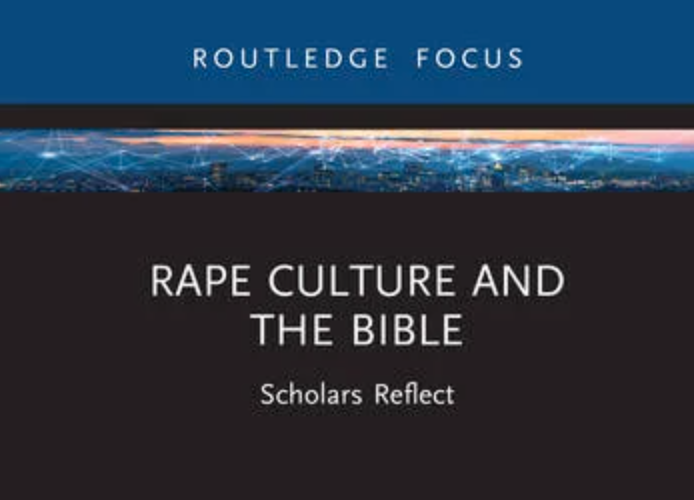
New Book! Rape Culture and the Bible: Scholars Reflect

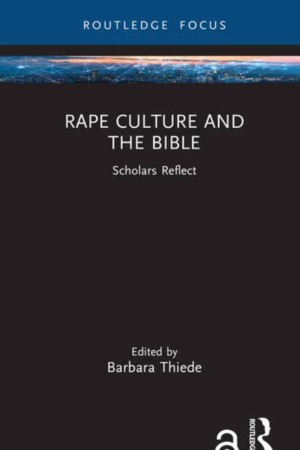
book cover with title Rape Culture and the Bible

We are very happy to announce a new book in the Routledge Focus series ‘Rape Culture, Religion and the Bible.’ This latest title is Rape Culture and the Bible: Scholars Reflect, edited by Barbara Thiede. The book is available for open access and free download here. It can also be ordered in hard copy.

This book is centred around a series of interviews with several key scholars in the study of rape culture, and of the Bible and sexual violence. The interviews were conducted online by Barbara Thiede, with Johanna Stiebert also present. Following this, the interviews were edited and approved by the interviewees. The interview chapters are given some context by Barbara Thiede in the form of an introduction and conclusion.

What this book makes clear is why and how the study of rape culture and the Bible matters. It also identifies key points of both illumination and friction. Given the immediacy of the interview format, this book is extraordinarily vivid and moving. We hope it stimulates further thought and research on a vital and multi-dimensional topic.

For excerpts from select interviews, see also our short film, here.

The scholars and scholar-activists interviewed are (in order of appearance in the book):

Lisa Oakley, Yehudis Fletcher, Gerald West and Sithembiso Zwane

Harold C. Washington, Pamela Gordon, Caroline Blyth and Mitzi J. Smith

Sandie Gravett, Ken Stone and Sarojini Nadar

Miryam Clough, David Tombs, Meredith J. C. Warren and Eric Vanden Eykel.

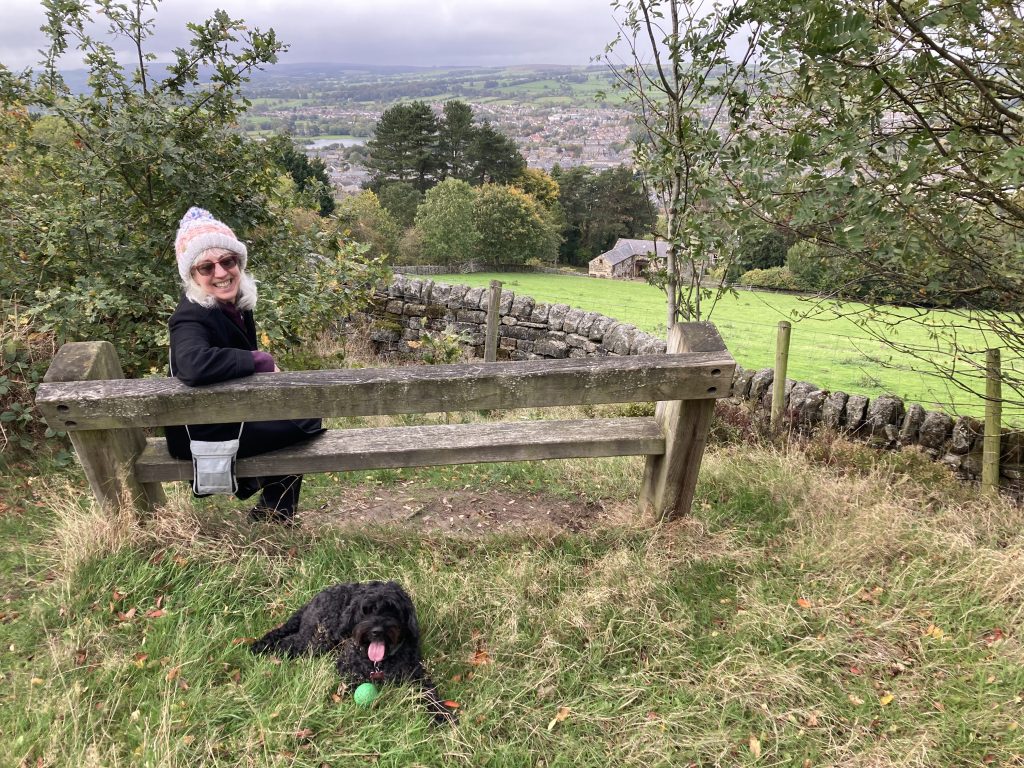
The image shows Barbara Thiede on her recent research visit to Yorkshire.

[Postscript: The Shiloh Project has been active since early 2017 and has not only this blog but a podcast, associated grants, and the book series. It is becoming harder for us to find time to do these many ‘branches’ justice. Several former co-directors have, understandably, stepped aside, finding themselves too busy to maintain the project. We are currently contemplating archiving the blog.]

read more

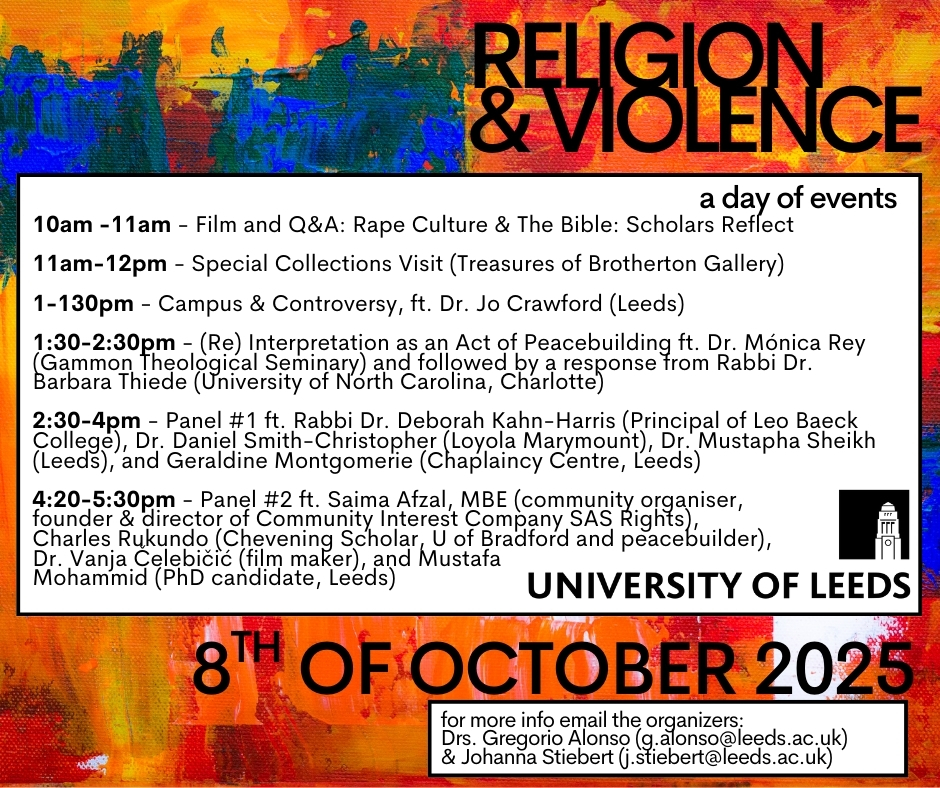
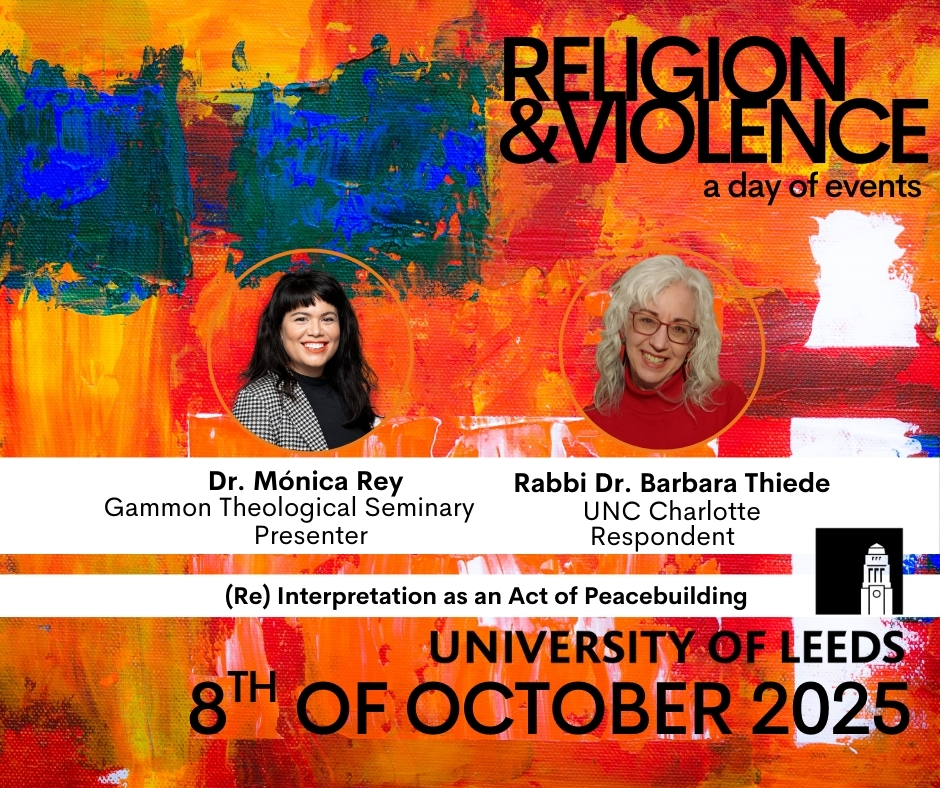
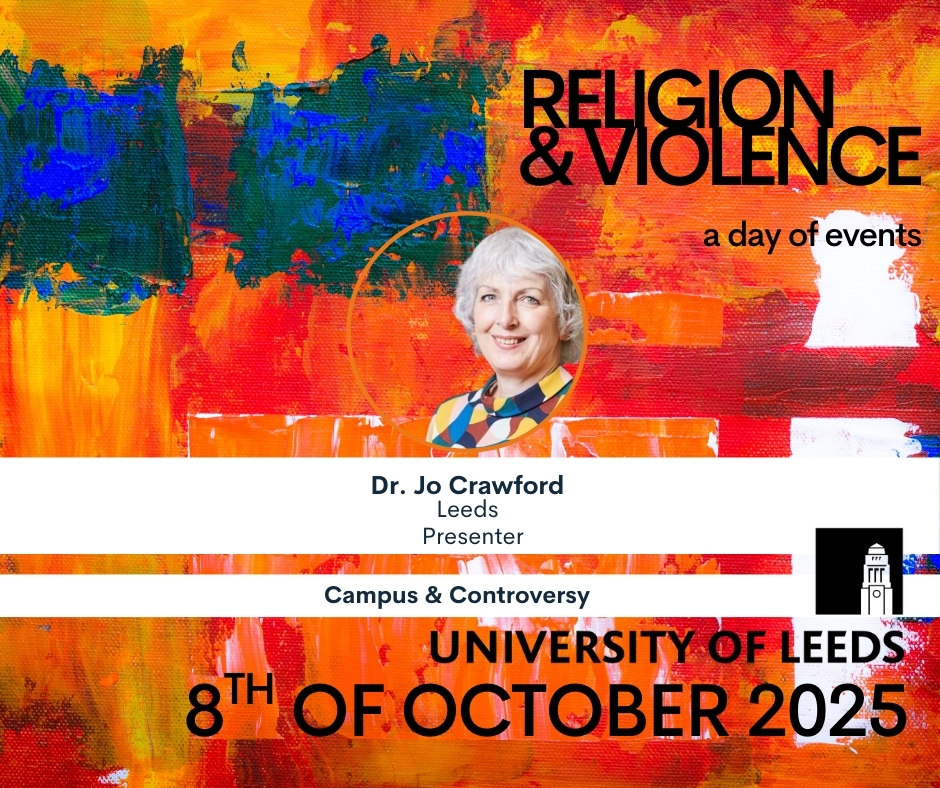
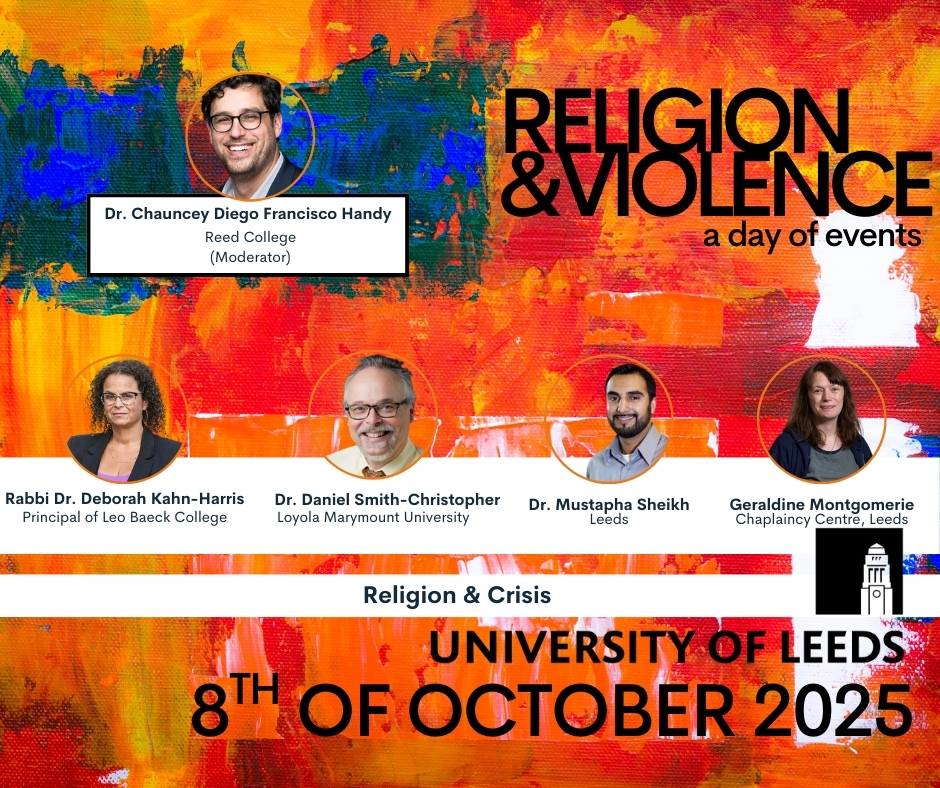
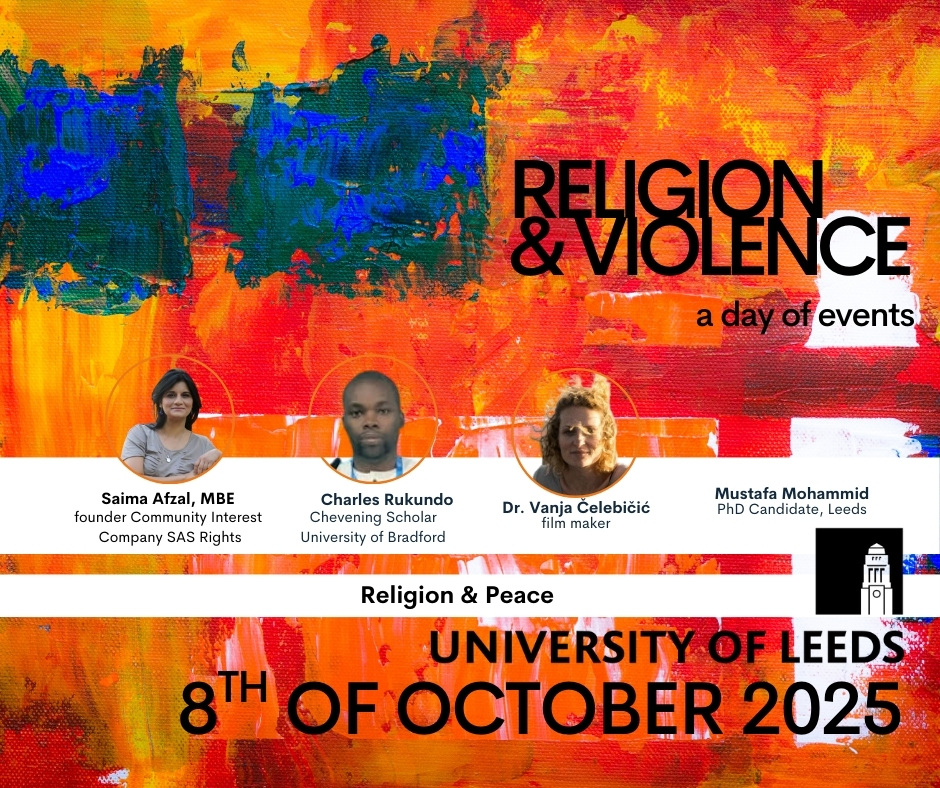
Religion & Violence – A Day of Events (8 October 2025, University of Leeds)

image announcing day of events on religion and violence

The Shiloh Project is featured in a recent profile on research at Leeds! See here.

And we now have an itinerary for our day of events on Wednesday 8 October on the campus of the University of Leeds. Alongside some visual displays by Kate Howe and Robyn Ashworth-Steen, as well as photographic panels from the recent Islamophobia display hosted by the University of Leeds Iqbal Centre, we have…

[The talented producer of the images wishes to remain anonymous. Thank you!]

read more

What has the Bible to do with Deepfake Porn?

Today’s post is by Tasia Scrutton. Tasia is an Associate Professor at the University of Leeds and Director of the Centre for Philosophy of Religion and Theology.

Tasia Scrutton

The Book of Daniel recounts the story of Susanna, a married woman who is spied on by two lecherous old men while she is bathing (chapter 13). [1] Realising that they both lust after her, the men conspire to blackmail her to have sex with her. When she refuses, the men have her arrested, claiming that they saw her have sex under a tree with a young man – a ‘crime’ punishable by stoning.

Just as she is about to be put to death, Daniel – the hero of the book – interrupts, arguing that the men should be interrogated to ensure that the sentence is just. Daniel separates the two men, asking each of the men what kind of tree they saw Susanna have sex under. The first claims to have seen Susanna and her lover under a mastic tree, the second under an evergreen oak. Mastic trees are small while oaks are large; the disparity between their accounts makes it clear that they are lying and that Susanna is innocent.

The court case against Susanna involves humiliating her: the old men demand that she remove her veil in court ‘so as to sate themselves with her beauty’, and she has to submit to them both putting their hands on her head when they testify against her (Daniel 13:32 – 34). We do not know whether the story of Susanna was based on a historical episode, but it seems reasonable to think that the background state of affairs that it relates (that a woman would be stoned for alleged adultery; that the burden of proof would be on her in court to prove her innocence; that she may have been subject to humiliation during the trial) reflect the time at which it was written, the second century BCE.[2]

Despite the geographical and historical distance between this narrative and our own contemporary context, there are remarkable similarities between Susanna’s story and an all-too-real, horrifying case today. On Sunday the BBC News recounted the story of Hannah, a young woman in Australia. Hannah discovered a website called ‘The Destruction of Hannah’, which involved hundreds of photographs of her face that had been taken from social media and stitched on to violent, pornographic pictures. The website also involved polls in which hundreds of people had voted on vicious ways they wanted to abuse her. Included on the website were Hannah’s full name, her Instagram handle, the suburb she lived in and, as Hannah later found out, her phone number.[3]

Like Susanna, Hannah had an ally – in Hannah’s case in her partner Kris, with whom she set about trying to find the culprit. Kris found photographs of other women on the website who were the couple’s friends, and the couple realised that the person who posted them and created the website must be someone they knew. Eventually they whittled it down to one person, Andy, a ‘friend’ in common with the different women whose images appeared on the website.

But also like Susanna, much less happily, it turned out that the justice system was biased against Hannah. Hannah recounted her shock when she reported Andy at the police station: “We thought they’d go grab him that afternoon”, but instead she was met with disdain. One police officer asked what she had done to Andy; another suggested that Hannah simply ask him to stop. Little was done by the police to protect Hannah, and her own innocence was even called into question when she reported the crime. In so doing, the police were perpetuating a common myth of rape culture: that the victim of sexual violence must have ‘asked for it’ in some way, whether by dressing in a certain way, or doing something to hurt or anger the perpetrator.

Like Susanna, Hannah’s case also involved humiliation from the legal system that should have been protecting her: one police officer even pointed to a picture of her in a skimpy outfit and said “You look cute in this one”. Because of the lack of adequate police response, Hannah and Kris spent £10,200 in order to hire a digital forensics analyst and a lawyer, and lived for a significant period with cameras all around their house, a knife by each side of their bed, and location tracking on all Hannah’s electronic devices. Kris monitored the pornographic website in case there was any sign of escalation while Hannah reported that “I stopped having windows open because I was scared…. The world for you just gets smaller. You don’t speak to people. You don’t really go out”. Another of Andy’s victims, Jess, told the court at which Andy was eventually sentenced that, “The world feels unfamiliar and dangerous, I am constantly anxious, I have nightmares when I am able to sleep”.[4]

The Book of Daniel was written over two thousand years ago, and it is tempting to assume that the circumstances of women have improved since then. And in many parts of the world, in many respects, they have. Since 1882 women in the UK have been able to buy, sell and own property; since 1928 they have been able to vote on the same terms as men and regardless of social class; since 1991 rape within marriage has been recognised as rape and considered a crime. But in other respects women in every part of the world are still subject to many of the oppressive patriarchal circumstances recounted in the tale of Susanna. They are still subject to sexual violence, harassment and abuse; the burden of proof is often still on them to prove their innocence and/or the perpetrator’s guilt; legal systems are often still biased against them, and humiliate and blame rather than protect them. As Hannah and Jess’ reports highlight, women are still often forced to retreat into small and private spheres, not because the law explicitly dictates it, but because the ongoing threat of sexual violence so often makes it the only comfortable and safe-seeming place to be. Stories like these tell us that getting justice for women is possible. But they also tell us that, until violence against women and the threat of violence against women is no more, women throughout the world still lives in oppressive structures surprisingly similar to those experienced by biblical women like Susanna.   

Image: Susanna and the Elders, by Artemisia Gentileschi. While many artists’ depictions of Susanna and the Elder in the Baroque era depicted Susanna for an objectifying gaze aimed at igniting male desire, Gentileschi depicts Susanna empathetically, capturing the sense of Susanna’s distress. Horrifically, Gentileschi was also later forced to carry the burden of proof for a sexual crime of which she was a victim and in which the legal system was biased against her, being tortured in order to ‘verify’ her testimony against the man who raped her. Through her empathetic depiction of Susanna, Gentileschi is an ally to women who are victims of violence, depicting the emotional turmoil to which it gives rise. Artemisia Gentileschi, Public domain, via Wikimedia Commons


[1] The story of Susanna is ‘deuterocanonical’ or ‘apocryphal’: it appears in the Catholic and Orthodox canon of the Bible but not in the Hebrew or Protestant one. You can read the text here: Daniel, CHAPTER 13 | USCCB

[2] See Numbers 5 for an earlier biblical example of women being publicaly displayed and humiliated in a legal context

[3] Woman’s deepfake betrayal by friend: ‘Every moment became porn’ – BBC News Accessed 9th February 2025, 16:35 GMT

[4] Woman’s deepfake betrayal by friend: ‘Every moment became porn’ – BBC News Accessed 9th February 2025, 16:35 GMT

read more

Royal Commission of Inquiry into Abuse in Care Report Released (Aotearoa New Zealand)

The Royal Commission Report on Abuse in Care in New Zealand was released on July 24, 2024. It considered the widespread abuse in care  in state and faith-based settings between 1950 and 2019. The findings are shocking: it is estimated that 256,000 (40%) out of 655,000 people in care suffered from physical, psychological, spiritual, and sexual abuse, including what amounted to “torture” in one health care institution. Feminist theologian Rocio Figueroa discusses some of the findings here.

It is quite paradoxical that at the same time that this report was released, New Zealand has once again been recognized as one of the world’s most peaceful nations, ranking number four globally at this time in history.[1] New Zealand’s high ranking is attributed to low levels of domestic and international conflict, minimal violent crime, and limited militarization. This lack of violent conflict, however, must not allow us to forget that there is a more subtle, hidden, and traumatic violence that hurts the most vulnerable in our society. Speaking about this more subtle and no less dangerous kind of violence, Nelson Mandela said:

“Less visible, but even more widespread, is the legacy of day-to-day, individual suffering. It is the pain of children who are abused by people who should protect them, women injured or humiliated by violent partners, elderly persons maltreated by their caregivers, youths who are bullied by other youths, and people of all ages who inflict violence on themselves. This suffering – and there are many more examples that I could give – is a legacy that reproduces itself, as new generations learn from the violence of generations past, as victims learn from victimizers, and as the social conditions that nurture violence are allowed to continue. No country, no city, no community is immune. But neither are we powerless against it.”[2]

It is heartbreaking that the most vulnerable individuals in New Zealand – including children, disabled people, Māori, Pasifika, and women – were the most severely harmed. The report reveals that Māori and Pasifika children and young people experienced higher rates of abuse compared to their non-Māori and non-Pasifika counterparts. It also identified that in addition to the trauma of sexual and physical abuse experienced by Māori and Pasifika peoples, there was often a loss of their cultural identity, language, and connection with their family and community.

Dr Rocio Figueroa

In her testimony, Paora Crawford Moyle tells of how she experienced sexual abuse after church functions, Sunday school, church picnics, and in parishioner’s homes. On top of that terrible sexual abuse, she also suffered cultural abuse: “At school I was targeted by my teacher for my behaviour and because I was Māori. I had an undiagnosed neurodiverse condition – I now know I have high functioning autism. I was constantly sent to the corporal punishment teacher, and was strapped with a large leather belt, or caned across the backside or back of my legs. I was 8 years old when I was first strapped, and this abuse continued for at least the next three years.”[3]

This is just one of many testimonies that highlights the intersection of racism and abuse, where multiple layers of trauma were created by the discrimination survivors encountered in care settings. Research about the relationship between poverty, racism and abuse, shows that Māori were more frequently placed into care, separated from their cultural roots and whānau (family), and subsequently experienced harsher treatment due to their ethnicity and skin colour. Today, one in five Māori or Pasifika families live in poverty, as opposed to half that rate – one in 10 – for Pākehā (those of European descent) families.[4] There is no way we will prevent abuse if we do not address the social causes that nurture violence: “a large volume of research, both internationally and in New Zealand, has found close links between poverty, deprivation, child maltreatment and neglect.”[5]

The report characterizes its findings as a “national disgrace”. As a Catholic theologian, I would say that it is also an “ecclesial disgrace.” Sexual abuse was found to be more prevalent in faith-based settings as opposed to state settings. About 2,300 people came forward to the Commission, bravely telling their stories and identifying themselves as having been abused in faith-based care settings between 1950 and 2019. Given these numbers, it is estimated that between 53,000 and 106,000 people may have been abused in faith-based care settings.[6] This estimate of the rate of abuse has been calculated mainly on international evidence.

It is already horrific the betrayal that they have suffered from people, who in the name of God, harmed them, but a second victimization has been the poor and inadequate responses to allegations, cover-ups prioritizing the image of the institution, and the lack of justice from faith-based communities.

I must also mention that the report noted that women within patriarchal structures in faith-based settings were disproportionately affected by abuse. While there is now more consciousness around addressing the abuse of children in faith-based contexts, when violence happens against young or adult women, it continues to lend itself to ambiguous interpretations. Churches often try to portray violence against women as if it were a consensual act, and even worse as a ‘romantic relationship’. For example, in the Catholic Church, in a pastoral setting there is a structural inequality and imbalance of power between priests and women. The report has strongly signaled that there have not been any signs from the Catholic Church to address the systemic factors that have enabled abuse. Referring to all Christian churches the report affirms: “Although early Christianity was notable for its respect for women, there is also a legacy of constraints on female leadership in the churches, despite frequent challenges from within. Although there have been changes over time, in all eight faiths the Inquiry investigated, clergy and religious leaders have been highly gendered with control historically held by males. Authority of males within faith-based institutions contributes to the occurrence of abuse (…) These patriarchal hierarchies within faith-based institutions contribute to a culture where disclosing abuse is discouraged and victims are unsupported.”[7]

The Commission made 138 recommendations to the State and faith-based communities. These include apologies, ensuring more transparency, implementing strong safeguarding polices, and establishing independent mechanisms to ensure accountability. I hope that all the recommendations will be implemented.

As faith-based communities, our commitment needs to be effective: reading and engaging with the report, digesting its content, and we believers in our own contexts have to ask what we can do to address the topic of violence in our communities and the systemic factors that enable it, and put in place all the measures to create safer spaces.

Dr. Rocio Figueroa is a Peruvian Catholic Theologian and survivor. Figueroa’s present research focus is theological and pastoral responses for survivors of Church sexual and spiritual abuse. Web: https://rocio-figueroa.com/


[1] Institute for Economics and Peace, Global Peace Index, 2024. Retrieved from: https://www.visionofhumanity.org/maps/#/

[2] Nelson Mandela, Foreword, World Report on Violence and Health, https://apps.who.int/iris/bitstream/handle/10665/42495/9241545615_eng.pdf?sequence=1

Accesed 16 August 2023.

[3] Paora Crawford Moyle, Survivor experience. Retrieved from  https://www.abuseincare.org.nz/reports/whanaketia/part-1/survivor-experience-paora-crawford-moyle/

[4] Mark Rashbrooke and Angie Wilkinson, Cracks in the Dam: The social and economic forces behind the placement of children into care. A report for the Royal Commission of Inquiry into Historical Abuse in State Care and in the Care of Faith-Based Institutions invisible forces destroying families in Aotearoa – independent research report. Retrieved from: https://www.abuseincare.org.nz/our-progress/library/v/552/cracks-in-the-dam-invisible-forces-destroying-families-in-aotearoa-independent-research-report, p. 24.

[5] Ibid., 27.

[6] Martin Jenkins, Indicative Estimates of the Size of Cohorts and Levels of Abuse in State and Faith Based Care 1950 to 2019. Final Report, 1 October 2020, Retrieved from: https://www.abuseincare.org.nz/our-progress/library/v/195/size-of-cohorts-and-levels-of-abuse-in-state-and-faith-based-care-1950-to-2019, 5. 39. “It has been used two approaches to estimate the numbers of survivors of abuse in State and faith-based care. The top-down approach starts with number of people in State and faith-based care settings between 1950 and now – ‘the Cohort’ – and uses data on prevalence of abuse (from New Zealand and international studies) to estimate the percentages of the Cohort who may have been abused. The bottom-up approach starts with the number of people in State and faith-based care (in a range of settings) between 1950 and now who have identified that they have been abused in care – the ‘known’ claimants of abuse. For present purposes, known claimants of abuse are treated as a proxy for the minimum possible numbers of survivors, given that recorded claims almost certainly represent a significant underestimate of true levels of abuse”. (p.5)

[7] Survivors’ experiences of abuse and neglect in faith-based care, Retrieved from: https://www.abuseincare.org.nz/assets/Whanaketia/Summaries/Summary-Faith.pdf

read more

The Woman from Judges 19

Hilary Willett (she/her) fights for gender justice by writing icons and reclaiming the lives of biblical women. Her most recent icon writes the unnamed woman whose story is found in Judges 19. Here, Hilary reflects on the process of writing this icon.

“The Woman from Judges 19” is one of the more confronting icons I have written. I knew I wanted to write it within a few months of learning iconography. I first read about this woman in Phyllis Trible’s book Texts of Terror.[1] Judges 19 tells the story of a woman in scripture who should be known and mourned everywhere, but is rarely discussed.

The woman in Judges 19 has no name. In many translations, she is rather crudely described as a “concubine” to a Levite man. In even less forgiving translations, she is described as an “unfaithful” concubine (ESV, NIV). But it is hard to know the precise nature of her relationship with the Levite. At times, the Levite is described as her “husband.” Some scholars speak of her as a “secondary wife.” For myself, I do not really want to describe her according to her relationship with a man. It is enough to know that this woman existed and that the biblical authors give her no name.

This unnamed woman appears to be in a fraught relationship with the Levite. While the woman from Judges 19 is not given much agency by the textual authors, she does leave the Levite man at the beginning of the narrative. She travels back home and is away for four months. This hint of autonomy, however, is short-lived. The Levite sets out with a servant, follows her to her home and is welcomed (“with joy!”) by the woman’s father. The father and the Levite enjoy food and drink for five days. The father does not uphold his daughter’s choice to live separately from the Levite in this moment, he focuses on male comfort and social expectations around hospitality.

On the afternoon of the fifth day, the woman’s father encourages the Levite to stay for another night. The Levite wants to leave (a deeply unwise decision). He takes the woman with him; there is no objection to her leaving with him in the text. As they travel, the Levite refuses to stop for the night at many of the safe havens they pass, preferring to keep travelling until they reach a Benjamanite town. Unable to travel any further, the Levite and the woman are stranded. The Levite is unable to find a place to keep them safe for the night.

Eventually, an older man takes pity on the Levite and shelters him, the woman, and the Levite’s servant. However, the house is surrounded by men who wish to rape the Levite man. To protect the Levite, the woman is cast out of the house. She is raped to death. She dies with her hands on the doorstep of the house.

But this story, as horrific as it is, gets worse.

The Levite cuts up the woman’s body and sends the pieces throughout Israel to incite war. Israel goes to war against the tribe of Benjamin, virtually wiping them out. Towns, people, and animals are destroyed, until only 600 men are left alive. Then, fearing a future where the tribe of Benjamin is eradicated, these armies kill the inhabitants of another town (Jabesh-Gilead), sparing only 400 virgin women. These women are given to the 600 Benjaminites to continue the bloodline of the tribe. The men left without wives are instructed to abduct still more women from Shiloh.

There is a reason we don’t often talk about this story. It is depraved. It is a story of extreme male violence and terror, of war justified by patriarchal sin. At the heart of this violence is a woman, whose name is absent, whose voice is silenced, and whose body is not her own. She is used, over and over, by men who care more about protecting their masculinity, upholding social expectations, and enacting vengeance. Her vulnerability is extreme – just like every innocent person who died in the fallout of war, just like every one of those 400 women from Jabesh-Gilead, just like every woman abducted from Shiloh.

To show such vulnerability in this icon, the woman is written naked. To show her stark reality, the shadows are deep; there is no colour apart from the red lines on her skin. These lines indicate where her body will be divided up. In the middle of some of the sections, a tribe of Israel is written on her body. This visual allusion drew upon butchers’ charts for inspiration, which divide up animals according to their meat cuts. Her face is hidden to highlight the absence of her name or any identifying feature. Finally, to show the utter horror of her situation, her halo is fractured, its pieces raining down on her body.

There is a reason why we should tell this woman’s story. It is because the story has not ended. There is so much war and violence occurring in the world today, so much justifying the unjustifiable. Every time we allow violence to reign in the home, in church, in society, and in politics, it is horrifying. Every time a vulnerable body is used, every time women are abused, every time innocent people become fallout or justifications for war, we need to remember this story and say very clearly: “No. No more. Never again. This ends here.”

Find more of Hilary’s icons – including the Woman from Judges 19 – at Lumen Icons: https://www.lumenicons.nz/


[1] Phyllis Trible, Texts of Terror: Literary-Feminist Readings of Biblical Narratives (Philadelphia: Fortress, 1984).

read more

Trauma and Theology Conference

Auckland, Aotearoa New Zealand

Earlier this year, St John’s Theological College (Anglican), Trinity Theological College (Methodist), and the Centre for Theology and Public Issues (University of Otago), jointly hosted a two-day Trauma and Theology Conference. This conference was led by Dr Karen O’Donnell, a specialist in theology and trauma, and the Director of Studies at Wescott House, Cambridge, UK.

During the conference, participants were invited to share some of their reflections. These reflections were filmed (with participants’ permission) and have been developed into a short film by two St John’s students, Scott Parekowhai and Grace Cox. This video highlights some of the participants’ impressions of the significant work that was covered in this conference. 

read more

Support to Survive

Support to Survive is a space which acts as a survival kit for those doing feminist, queer, decolonial, and trauma informed church work. In this post, Rosie Clare Shorter reflects with Tracy McEwan, Steff Fenton, and Erin Martine Hutton on why they started the Support to Survive community.  

When you begin a research degree, people throw all sorts of ideas and tips in your direction. ‘Keep your notes in a systematic manner,’ they say, at a university induction, as though no-one has ever recommended this before. And you nod diligently, and then go home to a hundred multicoloured Post-it notes scattered over your desk. ‘Write drunk, edit sober,’ suggests a parishioner during an online church service in the middle of Covid-19 lockdowns. ‘Research is lonely; find your people,’ was a common piece of advice at academic conferences.

Research certainly can be lonely, but it doesn’t have to be.

As we each worked on our respective research and wrote about gendered, racist, and sexist exclusion and harm in Christianity, we realised that our work was sometimes isolating. At times, it even felt alienating and risky. You can feel incredibly small when you stand up and call out heterosexist ideology. When you name sexism and racism within long-standing and well-resourced institutions. When you name it as harmful and violent. When you say that church teaching and culture can be a contributing factor in disaffiliation, intimate partner violence, homophobic, and transphobic harm and violence. Even when you know that there is a growing body of research behind you.

It can feel lonely, too, because this work can be not only theoretical and academic for us. It can be personal, and lived, too. For some of us doing this work, we have direct experiences of gendered, sexist, and racist harm within Christianity. We carry our own experiences with us as we research. As we hear the stories of others. It is also almost impossible to research and write about gendered, racist, and sexist exclusion and harm in Christianity without being impacted by what we read, hear, and learn.

Yet, our research also brought us together.  The more we did this work, and discussed it with each other we realised we weren’t alone, and we weren’t the only ones saying these things. We quickly realised that similar projects were happening across different faith traditions, from different angles, and in different disciplines; sociology, studies of religion, theology and biblical studies.

That’s part of why we started Support to Survive.

We started Support to Survive because we didn’t want to stand on our own, and we wanted a way to stay connected. We wanted to know we had someone to hold our hand when we didn’t feel brave. Someone to read our drafts when we felt unsure. We wanted peers to stand with, collaborate with and celebrate with. We wanted to cultivate health and healing together.  We wanted to slowly build a network, so that together we could have support to survive.

On our blog you’ll see the claim, ‘survival is a team sport.’ When you engage in feminist, queer, and decolonial work, having the support of others can be what keeps you afloat. Community keeps you going.  Sara Ahmed (2017, 235) contends that: survival ‘refers not only to living on, but to keeping going in the more profound sense of keeping going with one’s commitments. … Survival can be about keeping one’s hope’s alive; holding on to the projects that are projects insofar as they have yet to be realized. … Survival can thus be what we do for others, with others. We need each other to survive; we need to be part of each other’s survival’.

We’re not 100% sure what this space will look like as it grows. When we first discussed setting up some sort of network we had Ahmed’s depiction of a feminist killjoy survival kit in mind, and thought about how we could become part of each other’s survival kits. How we could help assemble a survival kit for others doing similar work. We firmly believe that if we are to keep on being committed to finding ways for religious institutions, organisations and communities to be safer and more inclusive, we need each other to survive. We might even find a way to thrive in this work as well.

In Complaint! Ahmed talks about how we chip away at institutional sexism, racism and violence. This work is slow, especially if you are chipping away on your own. We started Support to Survive because we wanted company while we chipped. We wanted to know we were chipping in the right places. We wanted support to keep on chipping away. We wanted to know someone else would carry on chipping when we were tired and needed a break. We wanted others to reassure us its ok to stop chipping when we need a break. We needed friends to encourage us to let go of the work when we were too close to it to realise. Working collectively matters. On our own, our voices are small, our chipping is minimal, but as Ahmed (2021, 277) reminds us, ‘we are not alone. We sound louder when we are heard together; we are louder’.

Doing this work in community is central to surviving.


We first imagined Support to Survive as a survival kit for people doing feminist, queer, decolonial and trauma-informed work and research within Christian organisations and communities. However, it is our hope that in time, Support to Survive will be an interdisciplinary and multi-religious space where many people share ideas and resources, and find a community of hope and healing. We want to create space for ‘coalitional thinking’ (Butler 2004, 11) – one of us might be particularly focused on how the religious institutions can contribute to primary prevention in Domestic and Family violence, while another is focused on how Christian churches can read the Bible to promote more expansive understandings of gender. Together, we can see how our specific projects contribute to broader conversations. Together, we can chip away at the walls of cisheterosexism and racism that are maintained by the harmful (mis)use of theologies and doctrines. Together, we can feel less alone. Together we are part of a movement of change.

We can support one another, even if the particular focus of our work is different. We want to collectively build a toolkit that contains a range of resources –  ideas, conversations, events, resources, friendships – that help us to do what we do. We’re hoping that our website can be a place where we can platform each other’s work, share new ideas on our blog and recommend existing resources. To get going, we’re hosting an online gathering on July 26 which will be a chance to think about what care and compassion looks like in our work and research practices.

Come join us as we slowly build a network and continue to chip away at sexism, queer exclusion, racism and violence in religious and faith-based settings.

Rosie Clare Shorter (She/her) is a feminist researcher interested in religion, gender and sexuality. She works in research and teaching roles at Deakin University, the University of Melbourne and Western Sydney University.

Tracy McEwan (PhD) (she/her)  is a theologian and sociologist of religion and gender at the University of Newcastle. Her research interests include women in Catholicism; domestic and family violence; and sexual and spiritual abuse

Steff Fenton (they/them) completed their Master of Divinity at the University of Divinity in 2021. They are a trans Christian speaker, writer, educator, and advocate who publicly shares the intersections of being queer and Christian. 

Erin Marine Hutton (She/her) is an award-winning scholar and poet whose interdisciplinary research is aimed at preventing violence.

read more

Accompanying Survivors of Sexual Harm: A Toolkit for Churches 

The Shiloh Project is pleased to announce the launch of a new toolkit called Accompanying Survivors of Sexual Harm. The toolkit has been developed as an educational resource for church leaders, inviting them to reflect on ways that churches can become spaces where sexual harm survivors feel safe and supported. This resource can be downloaded by following the link to the “Accompanying Survivors Toolkit” page on this website.

Below, Emily Colgan (one of the creators and editors of the toolkit) explains more about the toolkit’s development and its goals.

Accompanying Survivors of Sexual Harm: A Toolkit for Churches 

Accompanying Survivors of Sexual Harm is a trauma-informed resource that offers education and support of Christian clergy and lay leaders as they respond to sexual harm in their communities.  The resource is the collaborate effort of seven academics, all of whom work broadly at the intersection of sexual harm and Christian faith traditions in Aotearoa New Zealand. Through our work in this area, we have long been aware of the distressingly high rates of sexual harm in our communities, and we believe it is important for churches to recognise that the trends we see in society more generally are reflected in church communities as well. Moreover, churches need to acknowledge that sexual harm is perpetrated within these communities—at times by those in positions of authority—and the primary response of church leaders has far too often been one of self-preservation and concealment. For the most part, churches in Aotearoa have not yet found a voice to adequately address the issue of sexual harm, which is endemic in faith communities and in society at large. We (as a country, generally) have a problem with sexual harm and, for the most part, churches keep silent on this issue. 

This situation has come into sharper focus since February 2018, when the New Zealand government announced a Royal Commission of Inquiry into abuse in state care. In November of the same year, the inquiry expanded its scope to include abuse of those in the care of religious institutions. The harrowing testimonies of victims and survivors who experienced horrific sexual harm while in the care of religious institutions reveal that, for many people, churches have not been places of welcome and safety; they have not been places of good news. Churches have failed in their duty of care for the most vulnerable in their midst. The Commission’s work is still ongoing. But it has highlighted the urgent need for churches to be proactive in their support of victims and survivors, as well as in their efforts to ensure that church communities are no longer spaces where sexual harm can flourish. This resource is our – the contributor’s – response to this need. 

Over a number of years, we have canvassed stakeholders from within the Anglican, Methodist, and Roman Catholic traditions, seeking feedback about the educative needs of these churches for confronting the issue of sexual harm. We have also piloted this resource material with various church groups, seeking comment on the relevance and usefulness of its content for those in ministry. It reflects scholarship by experts in their respective fields, consultation with church leaders and those in frontline ministry positions, and insights and input from victims and survivors of sexual harm. It is by no means exhaustive, nor does it claim to be the full and final word on an appropriate Christian response to the issue of sexual harm. Instead, it enables workshop-based sessions which aim to educate clergy and lay leaders about

  • Understanding the nature of sexual harm and its prevalence in New Zealand society. 
  • Being alert to and responding in a pastorally sensitive manner to people within their community who have experienced/are experiencing sexual harm.  
  • Identifying and articulating some of the scriptural and theological foundations that work to justify/legitimise/enable sexual harm while silencing the voices of victims/survivors. 
  • Identifying and articulating some of the scriptural and theological foundations that work to challenge and resist sexual harm. 
  • Exploring how their church might work to create a safe space for victims/survivors of sexual harm. 

The toolkit will be of value to anyone in a church leadership position, including those training for Christian ministry and  those who have extensive ministry/leadership experience. It is intentionally ecumenical in nature and does not require knowledge of any one denominational tradition. While the format of the resource requires reflection and discussion in an “intellectual” sense, the aim of this work is to enable tangible, practical action in our communities that will support victims and survivors, and to make our churches spaces that are welcoming and safe. 

While some of the content relates specifically to the context of Aotearoa New Zealand, most of the material can be adapted and used further afield. There is space offered throughout the sessions for participants to discuss how issues pertaining to sexual harm relate to their own communities. Participants also have opportunities to consider how their own cultures, contexts, traditions, and languages will help shape their role of accompanying victims and survivors. 

The toolkit is free for anyone to download and use. It can be accessed here on the Shiloh Project website. If you have any queries about the use of the toolkit, please contact us at [email protected]

We hope this resource is a useful and meaningful tool for all those who accompany victims and survivors on their journey.

read more
1 2 3 10
Page 1 of 10